

THE ME SYSTEM
A simple practice for keeping yourself at the centre of your own life
The Life You’ve Built
You keep your home going. The children are fed. You already organise your time. All the demands don’t let up, and neither do you. You make it all work. More than well enough.
Often but not always, you take on the role of chief caregiver, organiser, coordinator, cleaner, chef, laundry washer, holiday booker, social secretary, animal feeder, gardener, decorator, ALL THE STUFF.
And somewhere in all of that, you start to disappear.
Your time fills, your attention is taken up, and your decisions are shaped by what needs you next.
Over time, you are no longer at the centre of your own life.
This is the problem the ME System solves.
It is built on a very simple observation: Everything and everyone has a place.
Your work has a place. The children have a place. The household has a place. Appointments, responsibilities, deadlines and commitments all have a place. The one thing often missing is you.
Most women don’t arrive here intentionally. Life and responsibilities simply accumulate. People need things. There is always something or someone requiring attention.
Before you know it, you become the person who remembers, organises, plans, anticipates, accommodates and responds. Your busy life gets built.
You often lead the process. Yet when you stop and look closely, it can be surprisingly difficult to locate yourself within it all.
You are highly skilled at creating a life that accommodates everyone and everything you care about. Family, work, responsibilities, friendships, ambitions for other people, practical realities and future plans.
Piece by piece, a full life takes shape. The difficulty is that you never quite make the same provision for yourself.
The Land Of LATER
Your own interests, ambitions, needs and desires are expected to survive on good intentions and whatever space remains available after everyone else has been resourced.
The business idea you can’t throw off. The novel you started years ago. The friendship you want to invest in. The gardening class you want to take. The afternoon you crave simply to sit and think. You develop an ongoing relationship with later.
Later when things calm down.
Later when the children are older.
Later when work is less demanding.
Later when there is more space.
Later is where a great many women end up living.
Over time, this becomes a form of self-exclusion.
You slowly move to the edges in the plans you make, the priorities you set, and the future you are building. The process is rarely dramatic. It happens through postponement. Or accommodation. And one decision after another to focus elsewhere.
Gradually, you become increasingly peripheral in the structure of your own life.
The ME System interrupts this pattern. It puts you solidly at the centre of your own life, so that what matters to you has a place again.
Because everything that matters gets a place.
You matter, you get a place too.

Start Using the ME System
Most women would answer yes if asked whether they matter.
The interesting question is whether their life reflects that.
You do not need special software or a complicated methodology to use, and benefit from, the ME System. Nor do you need to learn yet another productivity strategy.
The ME System is a practice.
I built the ME System as a mother of ten. I needed it to be deliberately simple. Something I could return to repeatedly, rather than complete once and forget.
Why?
I have very little patience for complicated systems. I don’t have the time, energy or bandwidth to learn a new methodology, maintain an elaborate planner, or spend hours organising my life. The system has to be simple enough to use in my full, ambitious, sometimes messy life.
It also has to do one thing well: keep me central in my own life.
It does.
And it can do the same for you.
All you need is a blank sheet of paper.
How to Use Your ME Sheet
Take your blank sheet of paper and set it in front of you. Draw two vertical lines down the page, which gives you three columns, and write a heading at the top of each.
The column in the middle is always named ME, and everything you write there is exclusively for you.
The two columns on either side are named whatever you need them to be — HOME and WORK on one sheet, CHILDREN and BUSINESS the next, CAREGIVING and FAMILY another. The headings shift; the ME column in the centre never does.

The point of the ME Sheet is not the sheet1.
It is that you cannot complete one without seeing the place you are giving yourself alongside everyone and everything else that matters.
Here is how I use mine as a weekly sheet.
On a Sunday evening I take fifteen minutes and one sheet of paper, and I name the right-hand column WORK and the left-hand column HOME. Everything to do with the house goes down the left, everything to do with work goes down the right.
Some weeks the labels change — DOMESTIC or KIDS instead of HOME, PROJECT DEADLINES instead of WORK — because the labels only ever describe the life I am actually running that week.
Fifteen minutes is not much, and that is deliberate: a system you dread is a system you abandon, so my ME Sheets have to be easy enough that I keep coming back to them.
Doing the food shop without the children does not belong in the ME column, even if you enjoy the quiet that comes with it. This task is still serving the household rather than you.
Reading something for an hour because you want to read it is a ME entry. So is a class you signed up for, or a walk you took for no reason except that you wanted the walk.
Filling the ME Sheet
There is no correct order, so start wherever it is easiest. Choose your headings, then fill in whichever columns come without effort. You do not have to begin with ME, and you do not have to fill the sheet perfectly. Honesty serves you far better than tidiness here!
When you have filled it in, look at how it went.
Which columns ‘wrote themselves’ first? Which headings were obvious before you had even picked up the pen? And when did you turn to the ME column — first, last, reluctantly, or not at all? Did the entries come easily, or did you have to dig for them?
This is worth paying attention to, because the order in which you fill a ME Sheet tells you something about the order in which you tend to place yourself. Most people, though not all, complete every other list before they get to their own. Noticing what you did is where the real work starts.
What Goes in the Other Columns
The columns on either side of ME reflect the life you are actually running, at whatever level of detail you need. Some days you want headings on a ME Sheet close to the ground — what is for dinner, whose turn it is to cook, what goes in the lunchboxes on Monday.
Other times you want them pulled right back — the year’s plan for your work, the house you are saving towards, the business you keep meaning to start. ME Sheets can hold focus on both micro and macro goals - you decide how near or how far out you are looking.
Take the HOME column. Up close, it is the small repeating detail of running a household: dinner, lunchboxes, the washing, and the daycare/school run.
Pull back, and the same column becomes the machinery behind all of that — when the proper shop happens and whether it is delivered or done in person, the trip to the market if that is your thing, the garden, the budget for the year.
You can keep a column tight to one thing, like “Summer holiday” or “Back to school”, or open it right out to “Career plan, next three years” or “Small business idea, six months”.
You can run several sheets at once: a daily one, a weekly one, a longer one for the year. And a big-picture column can have its own smaller columns feeding it, so a three-year plan on one sheet breaks down into the few real things that move it forward on another.
Before you decide how to carve up your ME Sheets, listen to these one minute nuggets from time expert Laura Vanderkam, and psychologist Jessica Chivers.
Laura Vanderkam, on rethinking how we actually spend our time.
Jessica Chivers, on how the load at home gets divided.
One thing to say plainly, because it truly matters, ME Sheet columns are not tidy. Your life is not three neat items per column, evenly balanced, and it never will be.
Some weeks the HOUSE STUFF column runs half the page while your SEX column (yes, plenty of people devote a column to this) contains only two entries. That imbalance is not a mistake. It is the truth of the week.
Write what is actually happening or needs to happen. Not categories but reality. Not “school admin” but “school run — see Ms Smith about the lost uniform”. Not “exercise” but “Tuesday swim, 12–1”. Not “be social” but “call Sarah and invite her to the sauna”.
Specificity matters. The more straightforward the entries, the more the ME Sheet can show you.
A single ME Sheet might look something like this:
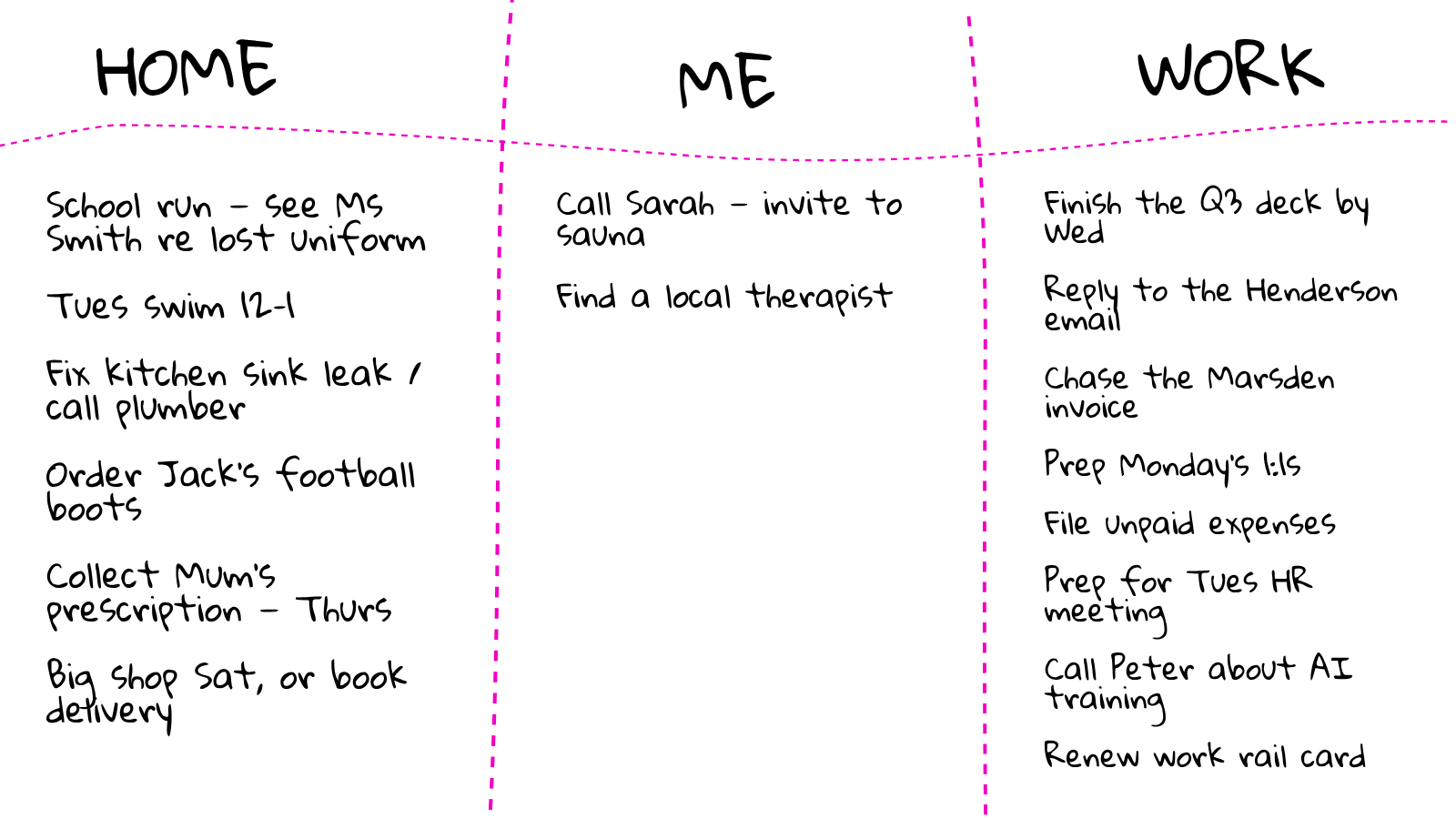
Notice the shape of it. Two columns crowded, one barely there.
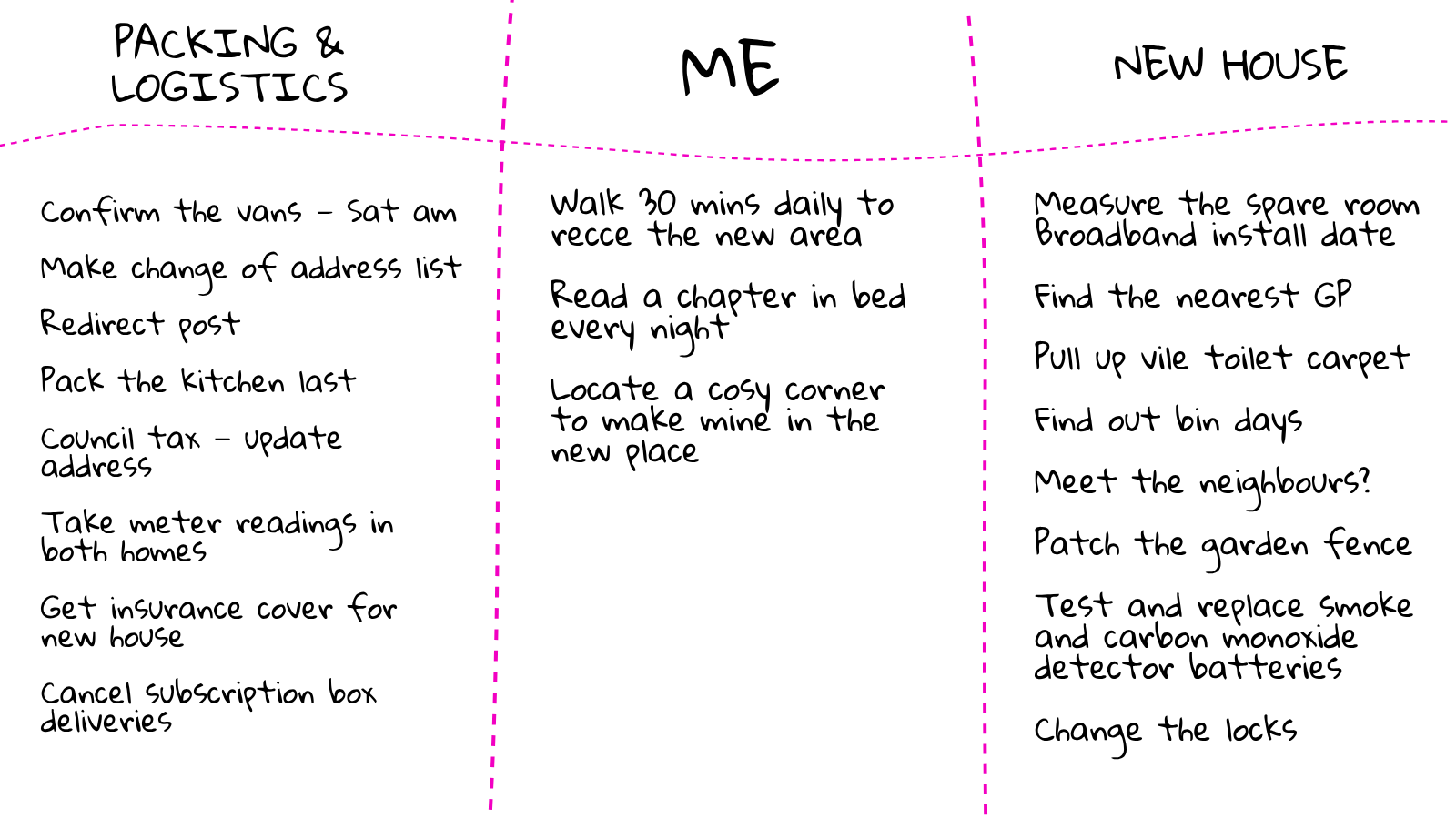
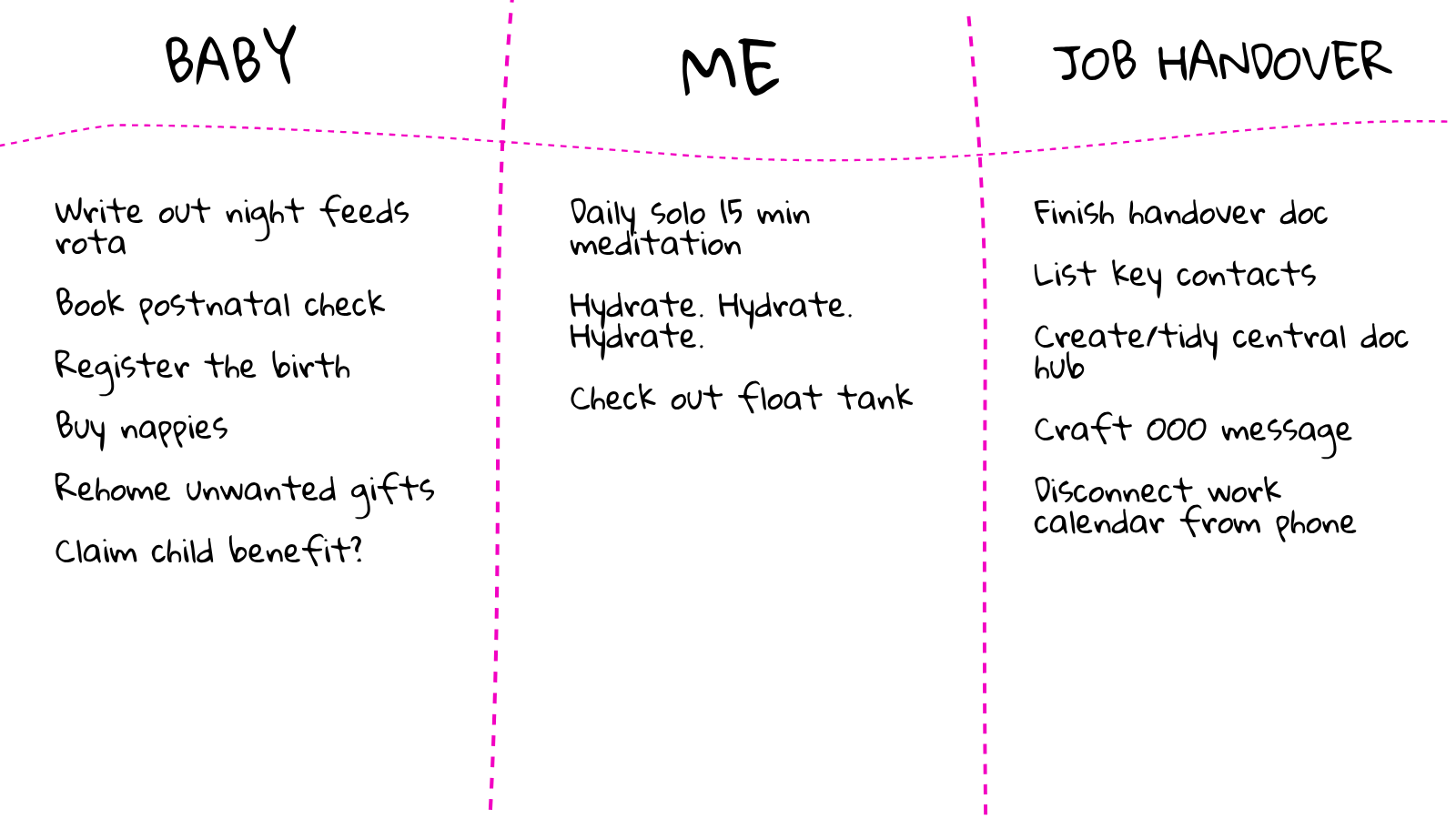
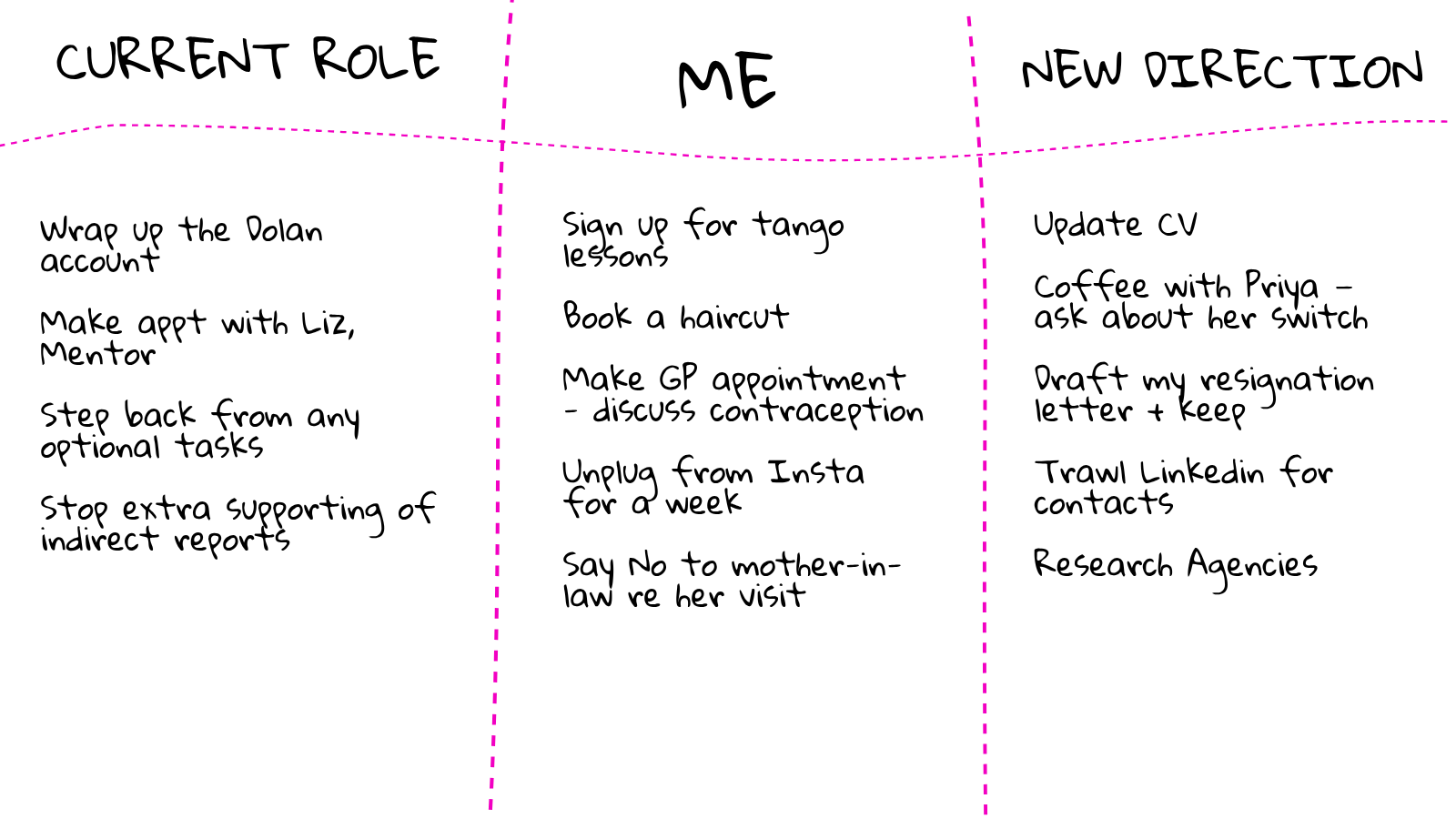
ME Sheets can also cover big transitions — stretches of life that reorganise everything for a while.
A house move. A career change. A new baby. A separation. A business you are getting off the ground. These are precisely the times you are most likely to vanish into logistics, and precisely the times the ME column stays vital.
When everything else is packing boxes or handover notes or first weeks/months with a newborn, the centre ME column is where you can focus on keeping yourself central amongst it all.
A few examples of how those ME Sheets might look:
So, What Goes in the ME Column?
You can probably name the other columns without thinking — work, the children, the house, the people you look after.
Let’s clear one myth out of the way first. A great deal of what gets filed under “self-care” is not really about you at all.
A proper meal, enough sleep, some exercise, a shower with the door shut — these matter, but they are maintenance. They keep you running so that everyone else can carry on being looked after.
Esther Perel draws the line well: what we tend to call self-care is often closer to self-reliance, the basic upkeep of a functioning person. Necessary, yes. The same as a life of your own, no.
The ME column is for what is actually yours. The secret interest you keep putting off. The work you would take seriously if you let yourself. The thing you find yourself thinking about when, for once, nothing is pulling at you.
It can be small, and it is rarely urgent, and it is almost never something anyone else will remind you to write down — which is exactly why it needs a column of its own.
Most of the messaging aimed at mothers points you towards the small and the soothing: the bath, the candle, the early night. There is nothing wrong with any of it, and if a long bath is something you genuinely want for its own sake, then it belongs on the sheet.
But if that is the only thing you are ever offered, it is fair to ask whether you have been handed a very small version of what you are allowed to want.
The ME column is bigger than that. It can take your ambition. It can take the thing you would be a little embarrassed to say out loud.
It is the one place where you are not required to be reasonable.
The test for the ME column is simple. Are you the one this is for? Not the household, not the children, not your employer or your clients or your mother, or your partner — you. That is the whole qualification.
Before you think anymore about what to put in the ME column, listen to these one minute nuggets from New York Times bestselling author Kate Baer, and tech entrepreneur Colleen Wong.
Kate Baer, on mothers taking back the right to focus on themselves.
Colleen Wong, on ambition, risk, and wearing more than one hat.

What You’ll Begin to Notice
Filled in once, a ME Sheet is a snapshot. Filled in again and again, it becomes something far more useful: a record of where your attention actually goes.
Over a few weeks patterns start to surface. You see which columns are always crowded and which stay thin, and some of that will be no surprise at all. But some of it will be.
You will spot the same friend’s name written down three weeks running and never called, a course that moves from one column to the next but never gets a date beside it, a week where ME holds a single line while the columns around it hold twenty.
You will also start to see what keeps coming back. Certain ambitions get stronger the more often you write them down. Others fall away, and you find you do not miss them.
The ME System will not tell you which is which — that part is yours. It simply makes the pattern clear enough for you to decide.
It is not here to turn you into a particular kind of woman with a particular set of priorities. It is here to make sure that, whatever you decide, you are central in the picture while you decide it.
The Empty ME Column
Sometimes the ME column just stays blank and empty. You fill everything else without trouble, the middle of the sheet has zero in it, and no matter how hard you push you cannot find a single thing to put there. This is not the exercise failing. This is the exercise doing exactly what it was built to do.
An empty ME column is one of the clearest things the sheet can show you. It is not proof that you have nothing worth writing down. It is a measure of how far you have drifted from the centre of your own life.
That is hard to look at. It is also more useful than almost anything else the sheet can tell you, because you cannot do a thing about an absence you refuse to see, and you can do a great deal about one you have written down in front of you.
So leave it empty for now, and let the blank space be the finding. The fact that you noticed it — that you reached for yourself and came up with nothing — is already the first mark in the column.
If you want somewhere to begin, these prompts can help:
➔ When I am in pain, in body or in mind, the kindest thing I could do for myself is…
➔ If my body could speak, it would tell me to…
➔ If my heart could speak, it would tell me to…
➔ What do I keep saying no to that I want to say yes to?
➔ What are three things I wish I knew more about?
Take whichever one lands and follow it.
Next time you create a ME Sheet (whether the next day or week), see if you can write one thing in the ME column. This does not need to be the ‘right’ or ‘worthy’ thing. It just needs to be one thing that is yours. That is how the column starts to fill: not all at once, but the way it emptied in the first place — one entry at a time.
A Few Questions [i am playing with a way to make the question and answers stand out, let’s try some different ones]
QUESTION: I can only think of two things for the ME column. Does it need to be full?
ANSWER: No. The ME column is not a quota, and a short list you mean is worth far more than a long one you padded out to look complete. Two things you actually want is a strong start. Write them down, and let the rest arrive in their own time.
What if everything I think of feels unrealistic?
Then those are some of the most important things on the sheet, and you should write them down exactly as they are. If something “unrealistic” keeps turning up in your ME column, that is not a thought to be talked out of — it is your own ambition showing you where it wants to go.
Often what looks unrealistic is really the distance between the life you have and the life you want: the savings target that doesn’t match the salary, the baby you want while you are on your own, the career you can picture but have not started. None of that is too big for the ME column.
The ME Sheet is not a promise to make it happen by Friday. It is the first place you let yourself admit it is there — and you cannot work towards a thing you will not even write down.
I could fill two whole columns with things I want for myself. Now what?
Good — that is a strong place to be standing. You are not short of things you want, which means the work for you is not finding them, it is making them happen. So start there. Look at the list, pick the one or two you would actually move on in the next month, and put real steps beside them: the email, the booking, the first hour.
You do not have to choose between everything you want today. You only have to stop pretending the list isn’t there and start bringing it to life, one entry at a time.
The Sheet You Return To
A ME Sheet is not something you finish. It is something you come back to. Lives change, responsibilities change, and the contents of your columns will change with them, so tear a sheet up and start again the moment it stops fitting.
Rename the columns, run three sheets at once, use it daily, weekly or only at the big moments — the system works for you, not the other way around. The single thing that never changes is the ME column in the middle.
This is where the system does its real work. There is a steady pull in most women’s lives back towards the edge: the expectations, the shoulds, the unspoken suggestion that wanting more for yourself is a bit much.
Every time you come back to The ME System, you push against that pull. You put yourself back in the centre — in your attention, in your time, and in your own sense of what you are allowed to want. Coming back is the practice. The ME sheet is just where it happens.
Here’s a final snippet to listen to, from New York Times bestselling author Eve Rodsky:
Eve Rodsky, on “unicorn space” and the endless claims on a mother’s time.
Final Reflection
Look back over the sheets you have filled in, and then answer these.
➔ What currently takes the greatest share of your attention?
➔ What deserves more of the page than it currently gets?
➔ What keeps reappearing in your ME column?
➔ What have you been treating as optional that is starting to look essential?
➔ What would change if you kept giving it a place?
The ME System begins with a sheet. The real question is what happens next.
Will you continue living in later?
Or will you give yourself a place alongside everything else that matters?
Want to Do This With Me?
My honest take: don’t let this turn into a “programme.” She already built the teaching — that’s the £29 course. If the group session also teaches, she’s doing the same work twice and spending the one thing she can’t get back. So the session should be the one thing the course physically can’t be: her, live, reacting to real sheets in a room of other mothers.
That single distinction collapses her prep to almost nothing. She isn’t building material. She’s showing up and responding to what’s in front of her.
Concretely, I’d run it as one live call, 75–90 minutes, hard stop:
Everyone arrives having already done at least one ME Sheet — they’ve done the course, that’s the entry condition. No catch-up time spent in the call.
Quick go-round: each person shows their sheet and points at the blank or thin ME column. The “it’s not just you” does its work here on its own, before Danusia says a word. They see it in each other.
She works a handful live: which entries are genuinely theirs, which are maintenance in a costume, and gives each person one concrete thing to put in the middle column.
Everyone leaves with one real ME entry. That’s the whole promise, delivered in a single sitting.
No homework, no follow-up calls, no DMs. The value is fully contained in the 90 minutes, which is exactly what keeps it survivable for someone with her life.
To protect her time around it:
Run it in rounds on a fixed slot she owns — say one evening a month — not on demand. She picks when she’s free; the waitlist fills the seats around her.
Let the waitlist trigger the round. Only set a date once enough names are on the list (6–8 is plenty). She never runs a half-empty call, and “the groups are small, so they run in rounds” stops being copy and becomes the actual operating rule.
Cap it around 6–10. Small enough that everyone gets airtime and it stays intimate; big enough that 90 minutes of her time serves several paying people at once. That’s the bit that makes the economics work — one and a half hours, six to ten people, modest price each.
Record for attendees only, if at all. Don’t sell the replay as the product. The live mirror is the product, and a recording can’t reproduce it.
The one trade-off to walk in knowing: live means a fixed time, and Parents Who Think has an international audience, so no single slot catches everyone. You don’t solve that — you let the cadence solve it. Miss a round, roll to the next.
If she ever wants it lighter still, the step down is a facilitator running the go-round while she only does the live reactions — but I wouldn’t reach for that until demand earns it. For version one, just her, one call, triggered by the list, is the least she can do that still delivers the real thing.
PRICING BY CLAUDE:
My honest answer: £59 per person for the first rounds, with room to move to £75–95 once it’s proven.
Here’s the reasoning, so you can defend the number to Danusia and move it if you disagree:
The course at £29 is your anchor. The session has to read as a clear step up from it, or the two blur together. That puts your floor around £45 — anything under that and a buyer can’t tell why this costs more than the thing they already bought. Live access to the founder, on their actual sheet, in a small room, is a different order of thing, and the price should say so.
Your ceiling is the brand. Parents Who Think is anti-fluff. The moment this prices like a £200 “transformational” coaching upsell, it fights the whole ethos of the ME System. So for v1 I’d not go above ~£95, and I’d start below it.
£55–65 is the sweet spot, and £59 is the clean anchor inside it. Above the course by a clear 2x, still squarely accessible to your audience, and — because it’s a demand test — it’s a real commitment without being a barrier. That last part matters: too cheap (£20–25) and a “yes” tells you nothing, because people say yes to cheap things they never show up for. £59 means the people on that waitlist actually want it.
What it earns her. Ninety minutes, 6–10 people, near-zero prep by design:
£59 × 6 = £354
£59 × 8 = £472
£59 × 10 = £590
That’s a good return on 90 minutes of her time, which is the whole point of keeping it group and keeping it live-only.
Two things to settle before it goes live:
VAT. If Parents Who Think is VAT-registered, decide whether £59 is inclusive or plus VAT, and show consumers the inclusive number. You’ve set this up before on the Stripe side — same call here.
One price, no tiers. Resist early-bird/tier complexity for v1. A single clean number matches the system’s plainness and keeps the waitlist simple. Raise the price for later rounds once you’ve got testimonials and a full list — that’s the natural moment to move from £59 to £75+.
One caveat worth saying plainly: this is a judgment call, not a formula. The number that’s “right” is the one Danusia can say out loud without flinching, to her audience, at her brand’s price level — so if £59 makes her wince in either direction, that instinct is data too.
People ask me how I run a business, raise ten children, and still get to the things that are mine. The ME System is a big part of the answer. This course shows you how the practice works, and you can run it on your own from here.
But the ME column — the middle one, the part that traps almost everyone — is the one I would want company for. So now and then I take a small group of mothers through it live: one session, ninety minutes. You come having already done a sheet or two, we put the real ones on the table, and I work through them with you — what is genuinely yours, what is upkeep that keeps everyone else running, and what to write in the middle column when it has sat empty. You see the same blank ME column in front of every woman in the room, and you leave with something actually in yours.
The groups are small, so they run in rounds. Add your name to the waitlist and I will let you know when the next one opens.
Here is Joy Foster, Founder of TechPixies, who has used ME Sheets for years, on what the practice has done for her.
[ SIGN-UP BUTTON / LINK EMBEDS HERE ]
The point is manyfold. ME Sheets allow you to get things done, to get better organised, to take action on important things, and most of all, to give centrality to your needs, wants, and desires.